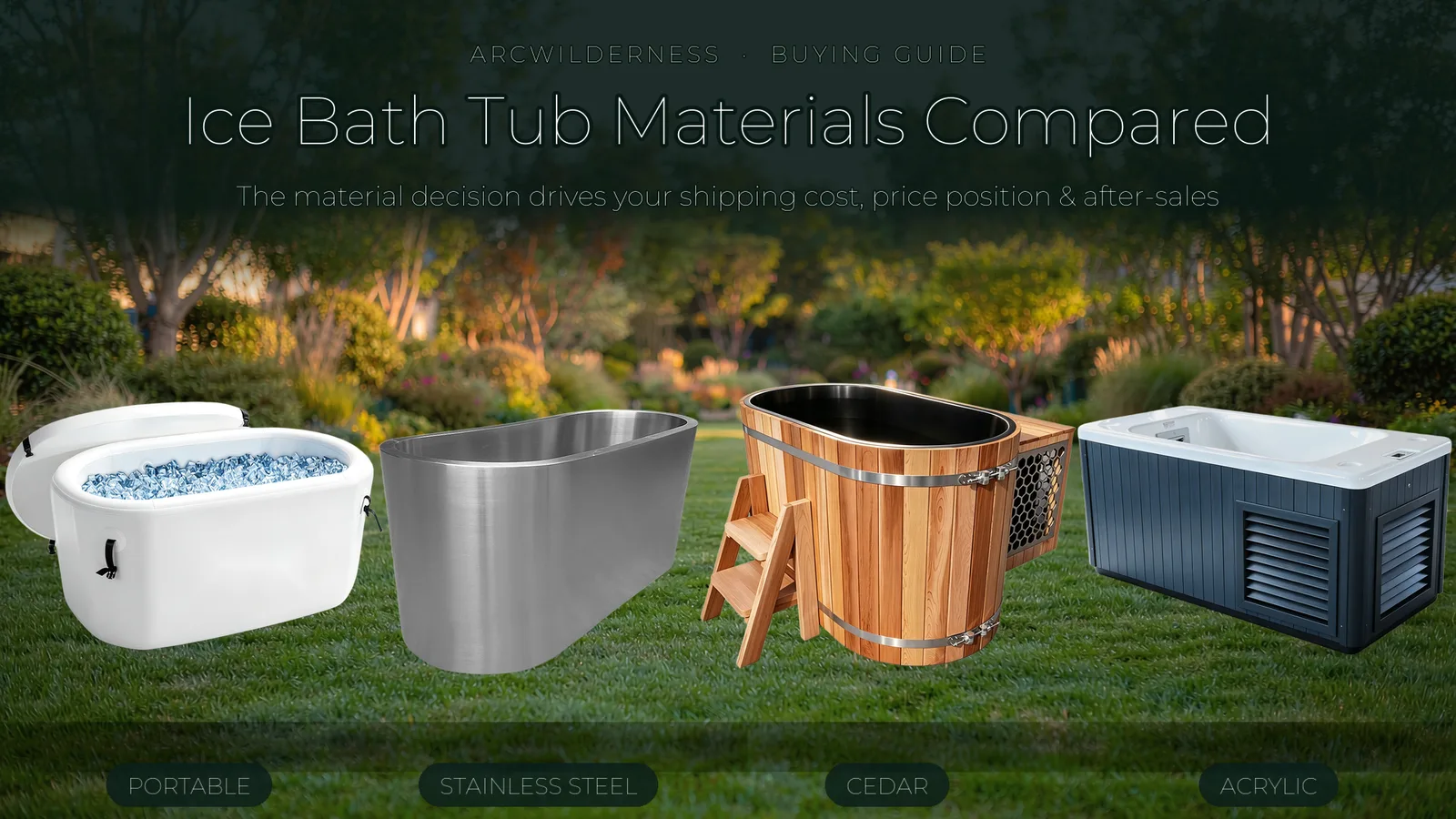
Ask two distributors which tub they prefer and you will get two different answers, because they are answering different questions. One is shipping into a rental market where the tub has to arrive flat-packed and leave in a car boot. The other is fitting out hotel terraces where the tub will never move again.
The material choice follows from that, plus your price position and how much support you are prepared to offer.
The four ranges at a glance
| Range | Typical use | Shipping & handling | What it asks of you |
|---|
| Portable and Drop Stitch | Home buyers, gyms, rentals | Lightest to ship, deflates or stacks | More customer guidance on setup and covering |
| Stainless steel | Permanent indoor installations | Bulky but robust | Careful handling to protect the finish |
| Red cedar with stainless liner | Permanent, visible installations | Heaviest — plan the delivery | Wood needs a cover and periodic attention |
| Acrylic all-in-one | Spa-style interiors | Large single unit | Confirm site dimensions before delivery |
Portable and Drop Stitch: the volume sellers
These run from 320 L up to 540 L in our range, seat one to two people, and ship with the tub, lid, air pump, handbag and repair valve. As a product line they are the easiest to start with: low freight cost per unit, several sizes to test, and market-standard fittings so a customer can add a chiller later.
The trade-off is that they are the range where end customers most often need help. Setup, inflating technique and remembering to use the cover are all part of the experience, so expect a support conversation with every sale unless the instructions reach the customer at the point of purchase.
Stainless steel: for permanent installations
Our stainless steel oval tub holds 450 L, seats one to two, and ships with a PU insulation cover. It is the range to recommend where the tub goes into an indoor recovery room or a spa and will not move again: dense walls hold temperature well, the surface is straightforward to keep clean, and the look suits commercial interiors.
Plan the delivery route before you sell it. Stainless tubs are heavier and bulkier than portable models, and a hotel installation with a narrow service lift is a delivery problem, not a manufacturing one.
Red cedar with a 304 stainless liner
This is our widest range, from 400 L to 650 L, seating one to two people, and it is the one buyers photograph. The cedar exterior carries the visual, the stainless liner carries the water, and the combination reads as permanent equipment rather than a temporary tub.
Two practical notes: these are the heaviest units we make, and the wood surface benefits from the supplied cover and some periodic attention. If you are selling into the premium end of a range, this is where the margin usually sits — and also where a delivery plan matters most.
Acrylic all-in-one
The acrylic range combines the tub body and surround in one 600 L unit, seating one to two, and is aimed at interiors where the tub is part of the fit-out rather than an object in the room. It is the range to discuss early with the customer's designer, because site dimensions and access decide whether the unit can be installed at all.
What distributors ask us most
- Can I mix materials in one container? Yes — mixed models can be consolidated into one container and we propose the shipping plan.
- Do the tubs only work with your chillers? No. Our tubs take market-standard fittings and can be paired with other suppliers' chillers, and our chillers work with other brands of tub.
- Are spares available for parts damaged in transit? Accessories can be ordered on their own with no MOQ, including after-sales replacement supply.
- What is the MOQ per material? 5 units for the stainless, wood and acrylic ranges, 100 units for most portable tubs, and 300 to 500 units on the pods, Incubators and ibt0001–ibt0003.
A range built from two or three materials usually outperforms a range built from one: the portable end brings volume, and the permanent end brings margin and reference installations.